
The Experiences You’re Losing Without Noticing
How small health declines quietly shrink your life.

I’m Brandon Wilson — a health consultant helping purpose-driven people take control of their wellness and become truly wellthy.
Each week, I share practical insights, biohacker-level strategies, and real-world wellness tools so you can make informed choices, elevate your energy, and build a body that supports your best life.
If you’re committed to investing in your health — not just learning, but actually upgrading — you’re in the right place.
👉 Join the Be Wellthy Club ($7/month or $70/year) for full access to 275+ past issues, bonus content, exclusive audio, private Facebook group, and book club access.
First time here? Welcome. Your future self is already thanking you.
In today’s newsletter:
A perspective on the distinction between not sick and healthy and the subtle cost of declining health
📰 Be Wellthy Breakdown of the recently retracted scientific paper widely cited to justify the safety of glyphosate, the active ingredient of Roundup.
Daily self-check-ins to be more mindful of your health
It took me a while to learn the lesson that time is more valuable than money. If you lose $20, you can earn it back; if you lose 20 minutes, you can't get your time back. I have also come to understand that health is more valuable than money.
“…health is actually a lot more valuable than money, because no amount of money can ever make up for very poor health—whereas people in good health but with little money can still have many wonderful experiences.” —From Die with Zero by Bill Perkins.
We tend to act as if wealth buys freedom, joy, and experiences. But in reality, health is the gatekeeper. It decides what experiences are even available to you—and how much you enjoy them once you’re there.
You can have time off, disposable income, and a bucket list and still quietly opt out of life because your knees hurt, your energy is low, or your body feels like a liability instead of an ally.
There is a distinction between not sick and healthy. We all know what it feels like to be sick, but think about the choices you make when you’re not ill but also not operating within your full potential.
Most people don’t explicitly say, “I can’t do that because I’m unhealthy.”
They skip the hike.
They pass on a day at the beach.
They avoid the stairs.
They say no to the spontaneous trip, the long walk, the physical play.
Sometimes it’s pain.
Sometimes it’s fatigue.
Sometimes it’s self-consciousness.
And sometimes it’s subtle enough that we call it “being realistic.” Or we say, “I’m too old for that,” or “I don’t feel like doing it.”
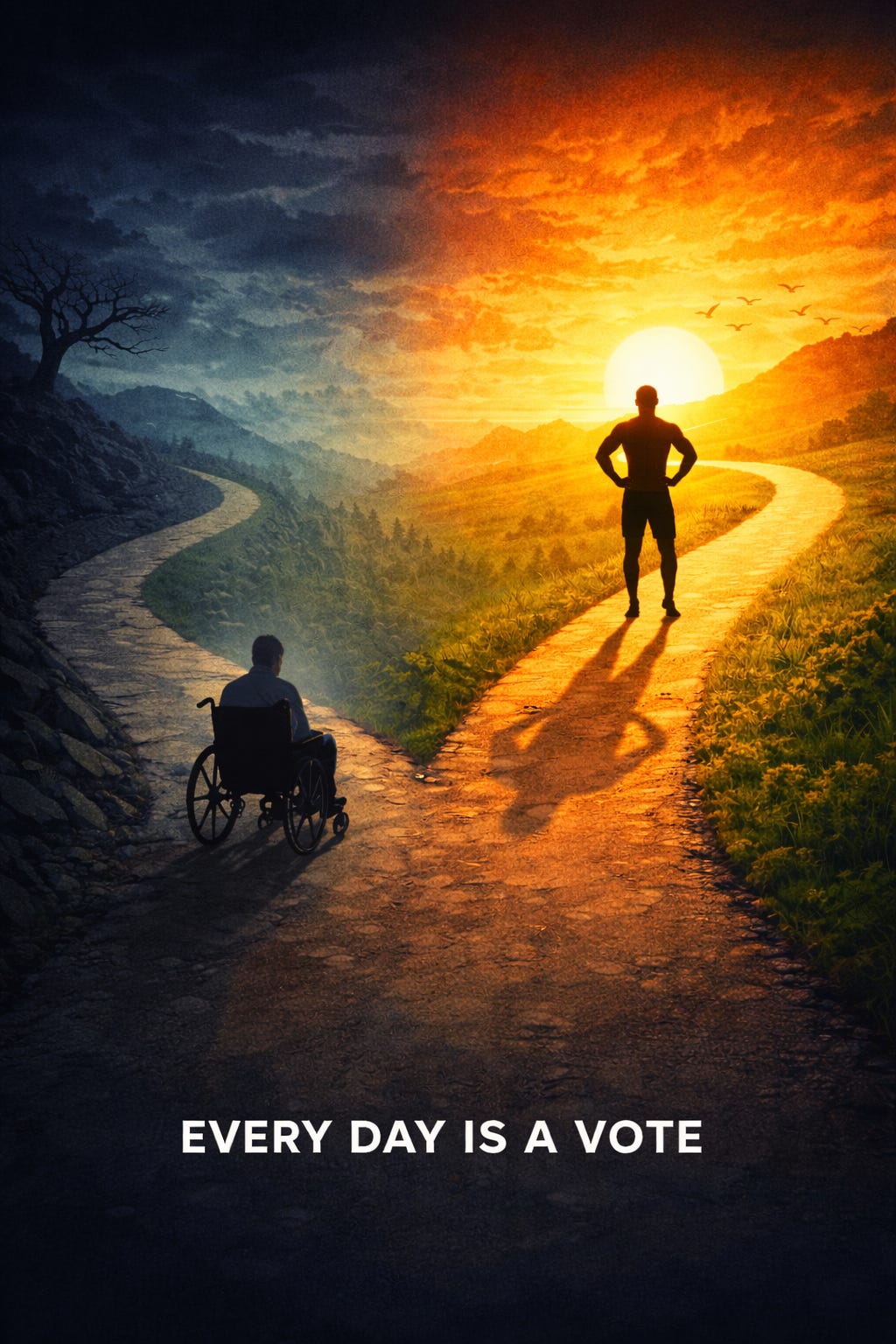
Here is what’s really happening: health quietly determines the size of your life.
![You can have 1000 problems in your life until you have a health problem. Then you only have one - Shoaib Hussain [1080 x 1350] : r/QuotesPorn](https://substackcdn.com/image/fetch/$s_!oCy3!,f_auto,q_auto:good,fl_progressive:steep/https%3A%2F%2Fsubstack-post-media.s3.amazonaws.com%2Fpublic%2Fimages%2F11538c0b-dbfe-49ed-9023-bff5d67f21ff_1080x1350.jpeg "You can have 1000 problems in your life until you have a health problem. Then you only have one - Shoaib Hussain [1080 x 1350] : r/QuotesPorn")
One of the most potent ideas in Die With Zero is that health compounds, just as money does. A slight decline today doesn’t stay small.
For example, ten extra pounds doesn’t sound like much—until you realize that each pound adds roughly four additional pounds of force to your knees. That’s forty pounds of stress your joints were never designed to handle with every step.
Discomfort and pain lead to less movement.
Less movement leads to more weight gain.
More weight leads to more discomfort and pain.
That’s negative compounding. But the opposite is also true.
A slight improvement—walking a little more, strengthening muscles, losing even a modest amount of excess weight—can slow the rate of decline and dramatically increase how much you’re able to enjoy life over time.
I’m not saying you need to be in perfect health. This is Be Wellthy, after all, and we’re here to enjoy life, not endure it. The goal is to achieve slightly better health than yesterday. Even a 1% improvement today can prevent years of negative compounding down the road.
Here’s the cold truth: unlike money, you can’t outsource this investment. You are in control of your habits, your movement, your food, and your daily choices.
As you move through this week, try sitting with this question:
“What experiences do I want my future self to be still able to say yes to?”
Then ask:
“What’s one small thing I can do today that protects that ability?”
That’s the Be Wellthy way.
Not extreme.
Not perfect.
Just intentional—before it’s too late.
📰 Be Wellthy Breakdown
A 25-year-old scientific paper frequently cited to support the safety of Roundup (glyphosate) has now been formally retracted. The paper—long treated as a cornerstone of regulatory decisions—was withdrawn after serious concerns emerged about conflicts of interest, ghostwriting, and selective data use. Investigations revealed that the review relied heavily on unpublished studies provided by Monsanto (now owned by Bayer), excluded other research raising safety concerns, and that Monsanto employees may have contributed to the paper without proper disclosure. The journal concluded these issues were severe enough to undermine the paper’s integrity.
Why this matters: Glyphosate has been widely used on food crops for decades, and a single paper has been repeatedly cited to reassure regulators and the public that exposure poses no human health risk. Its retraction—reported by outlets including The New York Times—comes at a critical moment, as the Environmental Protection Agency prepares to reassess glyphosate’s approval status.
My take: According to the EPA, globally, nearly 6 billion pounds of pesticides are used each year, and roughly half of that total consists of herbicides, making them the dominant category of pesticide use worldwide. Roundup-ready seeds (GMOs) yield crops resistant to glyphosate, and farmers also spray weedkillers on harvested crops to speed drying. In 2015, the International Agency for Research on Cancer (IARC) classified glyphosate as “probably carcinogenic to humans.” In 2018, a literature review concluded that large-scale glyphosate use may have health effects, including potential shifts in microbial composition and increased antibiotic resistance, and that further research is warranted on its associations with disease.
We hear the word “safe” used all the time, and it’s essential to understand what it means. Safe does not mean not harmful; it means without risk. If someone decides to consume alcohol and drive home intoxicated, it’s not safe, even if they arrive home without incident.
There are enough signals to be concerned about glyphosate, and it makes sense to minimize your exposure.
Simple Food Swaps to Reduce Glyphosate Exposure
If you usually eat this… → Try this instead
Conventional oatmeal/granola → Organic oats or organic oatmeal
Conventional wheat bread or pasta → Organic wheat, sourdough, or einkorn products
Conventional cereal → Organic cereal or eggs + fruit
Conventional chickpeas/lentils → Organic canned or dry legumes
Soy protein bars / shakes → Pea protein (organic) or whole-food snacks
Corn chips/corn snacks → Organic corn chips or root-based snacks
Oat milk (non-organic) → Organic oat milk, almond milk, or coconut milk
Processed snacks with corn/soy fillers → Whole foods: nuts, fruit, yogurt
Conventionally raised meat & dairy → Grass-fed, pasture-raised, or organic when possible
If all that is too complicated and you only switch one thing, switch oats, wheat, and legumes to organic.

The countdown is on to my next conference!
🔥 The most powerful event of the year is BACK. UNICON 3 is not just a conference—it’s a collision of destiny, vision, and exponential impact.
You’ll meet the partners, clients, and collaborators that could change your life. You’ll learn how to multiply your revenue through Golden Connections and create scalable impact by aligning your business with your Future Self.
🎯 If you’re serious about achieving unrealistic goals in 2026, this is the room you must be in. I will be there as a vendor representing Vital Health, and I’d love to see you there. Learn more and tickets here before prices go up soon!

The Daily Habit is where I share my habits related to the fundamentals: sleep, diet, physical activity, mindfulness, and stress management.
Pick one of these short check-ins and practice it every day.
Experience Check-In
Ask once per day:
“What experience am I protecting with today’s choices?”
(Walking pain-free. Traveling easily. Playing longer. Feeling confident.)Future Self Snapshot
Spend 30 seconds picturing yourself 10 years from now doing a regular activity—stairs, luggage, beach walk.
Then ask: “Did today help or hurt that version of me?”Language Swap
Replace “I should exercise” with
“I’m keeping my body capable.”
Small shift, big compliance boost.
Be Wellthy Club Member exclusives for this newsletter:
Audio commentary
The major step I’m taking in my health journey
Additional resources and a book recommendation to learn more about pesticides in the food supply and how to minimize exposure
