
The Great Sunscreen Paradox
Why the sun may not be the villain, sunscreen may not be magic, and the real answer is smarter exposure.

I’m Brandon Wilson — a health consultant helping purpose-driven people take control of their wellness and become truly wellthy.
Each week, I share practical insights, biohacker-level strategies, and real-world wellness tools so you can make informed choices, elevate your energy, and build a body and mind that support your best life.
If you’re committed to investing in your health, not just learning, but actually upgrading, you’re in the right place.
First time here? Welcome. Your future self is already thanking you.
In today’s newsletter:
A study of 470,000 people found that sunscreen use was associated with higher rates of skin cancer. Here’s what it was actually measuring.
The Swedish study that found avoiding the sun carries a smoking-level mortality risk
Why the best evidence on sunscreen and melanoma contradicts the most-cited evidence
A reasonable sun-safe protocol for this summer
Summer is in full swing in the northern hemisphere, and it’s the perfect time to address the topic of sun exposure, skin cancer, and where sunscreen fits into the equation.
Recently, I started seeing references to a study of 470,000+ people that found that sunscreen users had dramatically higher rates of melanoma, basal cell carcinoma, and squamous cell carcinoma, even after controlling for age, skin type, and sunburn history.
Cue two reactions: “I knew sunscreen was a scam,” or “That can’t be right, everyone knows sunscreen prevents cancer.” As with many controversial topics, the science is not settled, and the takeaways are nuanced. I went down the rabbit hole on this one for my own edification, and I’d like to share what I found.
The study everyone’s citing wasn’t about sunscreen
The paper in question is a 2023 UK Biobank analysis by Jeremian et al., published in Cancer Epidemiology, Biomarkers & Prevention. Here’s the thing almost nobody reporting on it mentions: this study was not designed to test whether sunscreen causes cancer.
The purpose of the study was to find genetic markers (specifically SNPs in DNA repair genes) that predict skin cancer risk. Sunscreen use was just one of eleven demographic/behavioral variables tossed into the model alongside skin color, tanning ability, and sunlamp use.
Sunscreen wasn’t the hypothesis. It was a control variable that generated a weird, unexpected result buried in a paper mostly about genetics. That actually makes the finding more credible (nobody was fishing for this headline), but it also means the study was never built to isolate sunscreen’s real effect.
The number everyone’s quoting
The viral stat of 292% higher melanoma risk in sunscreen users is real and derives from the paper’s own tables. Frequent sunscreen use was associated with elevated risk across all four cancer types studied.
Here's what bugged me: the study’s own authors found this same result and explained it away in two sentences. They attributed this finding to more overall sun exposure, inconsistent reapplication, or people using more sunscreen after a diagnosis, without testing any of those explanations, and then wrote their conclusion as if “use more sunscreen” were still the obvious takeaway. You don’t get to find a huge, four-for-four paradox and wave it off. Either you don’t know what it means yet, or you’re protecting a conclusion you already had.
So does sunscreen cause cancer?
Almost certainly not directly. Here are a few reasons that stand out:
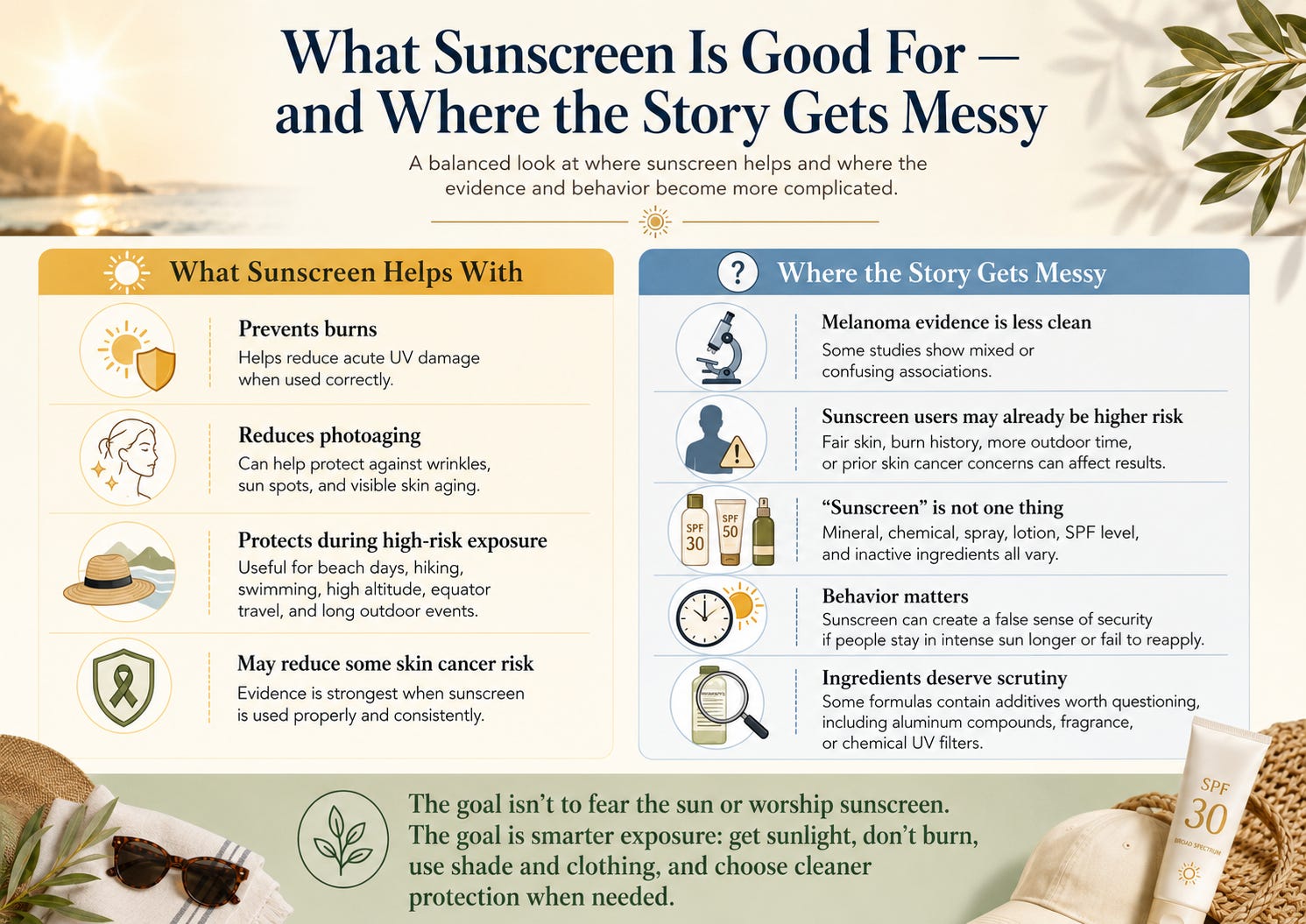
“Sunscreen” isn’t one thing. This is a category error. The study lumped every kind of sunscreen, chemical UV-absorbing formulas and mineral/physical zinc-based ones, into a single category. A 2007 letter in Free Radical Biology and Medicine found detectable aluminum in every sunscreen product tested, including ones that didn’t list it as an ingredient. Aluminum is a known pro-oxidant. If a meaningful chunk of the “sunscreen” category is quietly loading people up with a pro-oxidant compound, you’d expect exactly this kind of paradoxical signal, having nothing to do with sun protection itself.
Reverse causation is a real possibility, and the authors admitted it without testing it. People more prone to sun damage (or already diagnosed with cancer) tend to use more sunscreen. That’s cancer risk driving sunscreen use, not the other way around.
The broader melanoma literature is genuinely split by evidence quality, not just noisy. A 2018 systematic review and meta-analysis pooling 29 studies and 300,000+ participants found no significant association between sunscreen use and reduced melanoma risk, but that pool is mostly observational. A randomized trial in Australia found daily sunscreen use cut melanoma rates roughly in half compared to discretionary use, with an even stronger reduction in invasive melanoma (though the result was on the edge of statistical significance (p=0.051). Sunscreen’s case is much cleaner for squamous cell carcinoma. For melanoma, the type of evidence you trust actually changes the answer, which is uncomfortable given it is the most dangerous form.
It’s worth noting that sunscreen does help with skin aging. In a 4.5-year randomized trial, daily sunscreen users had 24% less visible skin aging compared to discretionary users.
None of these studies provide a clear picture of sunscreen use. It means we don’t fully know, and anyone selling certainty in either direction is overselling.
The blind spot both sides are missing
Skin cancer is not the only outcome that matters. A 20-year Swedish cohort study of nearly 30,000 women (the Melanoma in Southern Sweden cohort) found that women who avoided sun exposure had a shorter life expectancy than women with the highest sun exposure, driven by higher cardiovascular and non-cancer mortality. The researchers’ own comparison is shocking:
Nonsmokers who avoided the sun had a life expectancy on par with smokers who got the most sun.
Let that sit for a second. Sun avoidance showed up as a mortality risk factor on the same order as smoking.
Sunlight also drives circadian regulation and vitamin D synthesis, and time spent outdoors tends to accompany movement and better sleep. Optimizing one number (skin cancer risk) while ignoring everything else the sun does to your body is the same mistake I keep seeing across health in general. We want to know what actually helps you live longer and better, not what moves a single metric in isolation.
Know someone who loves the sun or avoids it at all costs? Share this newsletter with them.
Tips for a Safe and Sunny Summer
This is not medical advice. This is where I landed after my research.
Get outside early and often—for circadian rhythm, not a tan.
Build tolerance gradually. Your skin has its own endogenous protection system (melanin production) that ramps up with gradual, repeated exposure. Skipping the sun all spring and then going hard on the first hot beach day of summer is how people burn. Obviously, darker-skinned people have more built-in protection than people with lighter skin.
The only rule that actually matters: don’t burn. A burn is the thing that’s clearly and consistently linked to skin cancer risk across the literature.
When you do need protection, reach for mineral (zinc oxide or titanium dioxide) over chemical formulas. These are the two sunscreen active ingredients the FDA still considers to have sufficient safety data.
Minimize consumption of problematic omega-6 seed oils, e.g., canola, corn, cottonseed, soybean, sunflower, grape-seed, rice bran, and safflower. Omega-6 fats are more chemically fragile than saturated fats. When stored in skin tissue and exposed to heat, UV light, and oxidative stress, they oxidize more readily. Biohacker Matt Blackburn has suggested that a diet rich in vitamin E, along with supplementation to address any deficiency, is key, as vitamin E is the strongest lipid antioxidant.
Watch out for water, snow, altitude, and equator-adjacent UV where you may not have the “hot” feeling that cues you to protect yourself.
Hats, shade, and light clothing are underrated technology. A wide-brim hat is one of the simplest, lowest-downside interventions available. It doesn’t interfere with vitamin D production the way full-body sunscreen might, and it doesn’t carry any of the open questions about topical absorption.
Biohack your UV exposure. Consider tech like SpotMyUV patches that change color based on UV exposure or the The 90™️ Gem, a necklace that pairs with an app to provide customized guidance.
Get suspicious moles checked, regardless of what you believe about sunscreen. Early, localized melanoma has a very high survival rate. Late-caught melanoma is a completely different game.
Bottom Line
A study gets run for one reason, spits out a surprising result nobody was looking for, gets waved away quickly, then goes viral stripped of context. The useful version of this story isn’t “sunscreen causes cancer” or “it’s all settled science.” It’s that sunscreen isn’t a single product, melanoma research is messier than public health messaging admits, and sun avoidance carries real costs of its own. Don’t fear the sun. Respect it, and treat any single-number verdict, in either direction, with some suspicion.
Go outside today. Just don’t get crispy about it.

The Daily Habit is where I share my habits related to the fundamentals: sleep, diet, physical activity, mindfulness, and stress management.
Here are two phone apps that are useful for tracking daily sun exposure based on your location to maximize vitamin D synthesis and avoid sunburns.
Be Wellthy Club Member exclusives for this newsletter:
Audio commentary
Additional resources for a deeper dive into sun exposure, including a book recommendation
My recommended brands for clean sunscreen and my go-to product after prolonged sun exposure to moisturize and revitalize your skin
Tips for choosing the best SPF for your circumstances
👉 Join the Be Wellthy Club ($7/month or $70/year) for full access to 300+ past issues in the archive, bonus content, exclusive audio, a private podcast RSS feed, and a private Facebook group.
