
Stop Talking to Everyone the Same Way
One conversation. Four different filters. Here's how to recognize them.

I’m Brandon Wilson — a health consultant helping purpose-driven people take control of their wellness and become truly wellthy.
Each week, I share practical insights, biohacker-level strategies, and real-world wellness tools so you can make informed choices, elevate your energy, and build a body and mind that supports your best life.
If you’re committed to investing in your health — not just learning, but actually upgrading — you’re in the right place.
First time here? Welcome. Your future self is already thanking you.
In today’s newsletter:
The four-color framework for understanding dominant personality types
Tips and strategies to improve your communication and relationships

When I was a middle school teacher in South Phoenix from 1999 to 2001, I saw personality patterns play out every day in my classroom. Teachers aren’t supposed to play favorites, but if I’m being honest, some students were easier for me to connect with than others.
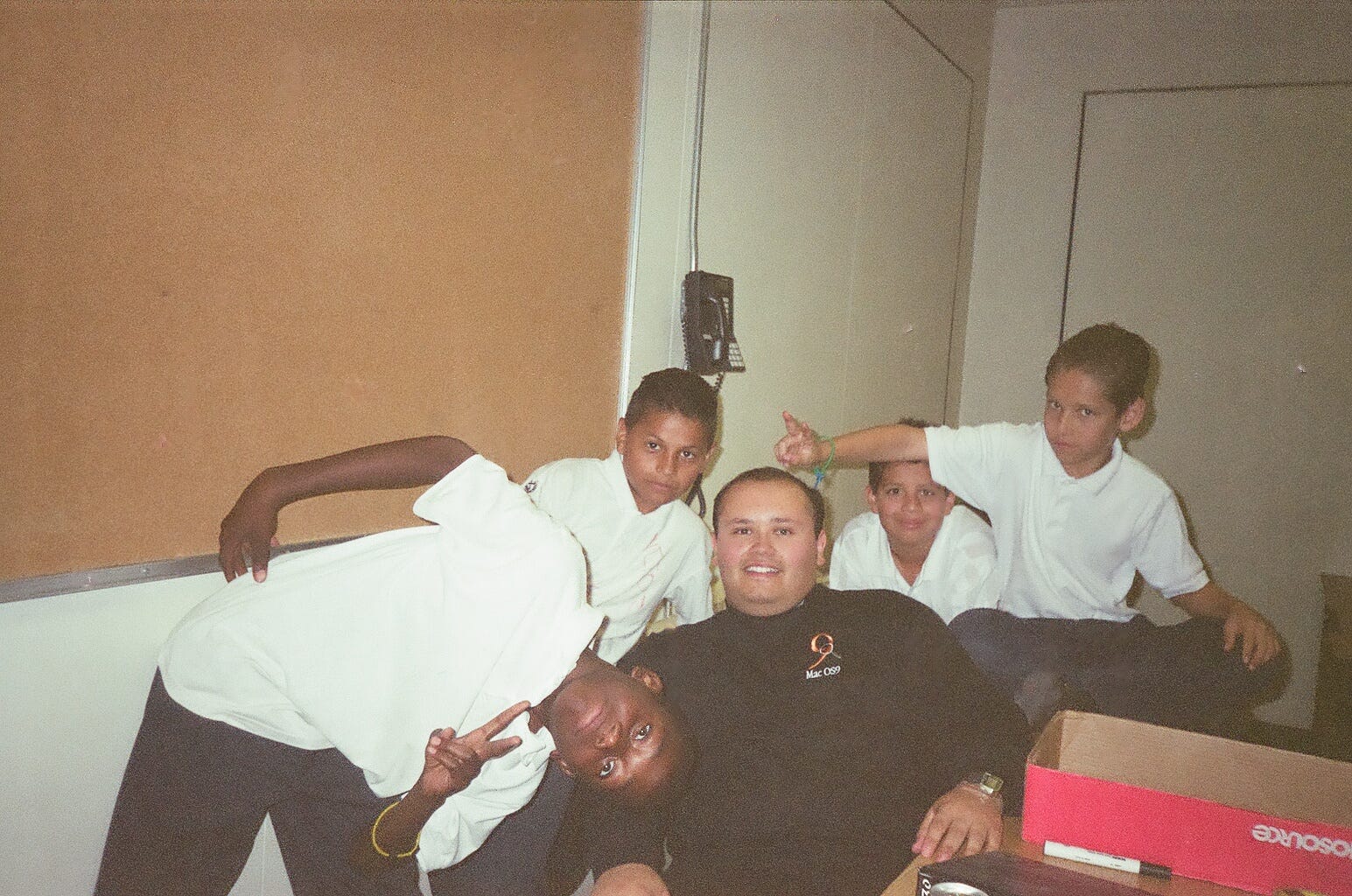
I naturally appreciated the students who were a lot like me. They followed directions, paid attention, appreciated logic and mathematical concepts, and didn’t cause me any problems. They were curious and thoughtful, and they liked understanding how things worked.
I also enjoyed the students known as “teacher’s pets.” They were the first ones to volunteer to sharpen pencils, bang together the chalkboard erasers outside, clean up the classroom, organize supplies, or help another student. They wanted to be useful and contribute.
Then there were the class clowns. They were late to class, loved to talk, and could barely sit still. They were the first ones out to recess and the last ones to come back. Sitting quietly for a test felt like torture, but give them a group activity, a chance to perform, or something with movement and energy, and suddenly they came alive.
And then there were the students who always wanted to be in charge. They didn’t listen because they had a better way to do everything. They wanted to tell the other students what to do. They were competitive, opinionated, and very aware of who was winning. They could be challenging, but they also had a certain drive and confidence that, when channeled well, could become leadership.
Looking back, I can imagine how many of those same kids are operating as adults.
Some became helpers.
Some became entertainers.
Some became leaders.
Some became analysts.
And all of them probably still hear the same message in very different ways.
Have you ever shared something you were genuinely excited about, only to get four completely different reactions?
One person wants the facts.
One person wants to know who else is involved.
One person wants to know whether it will actually help people.
One person wants the bottom line and the next step.
Same message. Same opportunity. Same conversation.
Totally different filters.
That’s where the four color personalities can be surprisingly useful.
Most people communicate the way they like to receive information. But communication improves when we learn to speak in a way the other person can actually hear, process, and respond to.
The Four Colors
Yellow (the helper) 💛
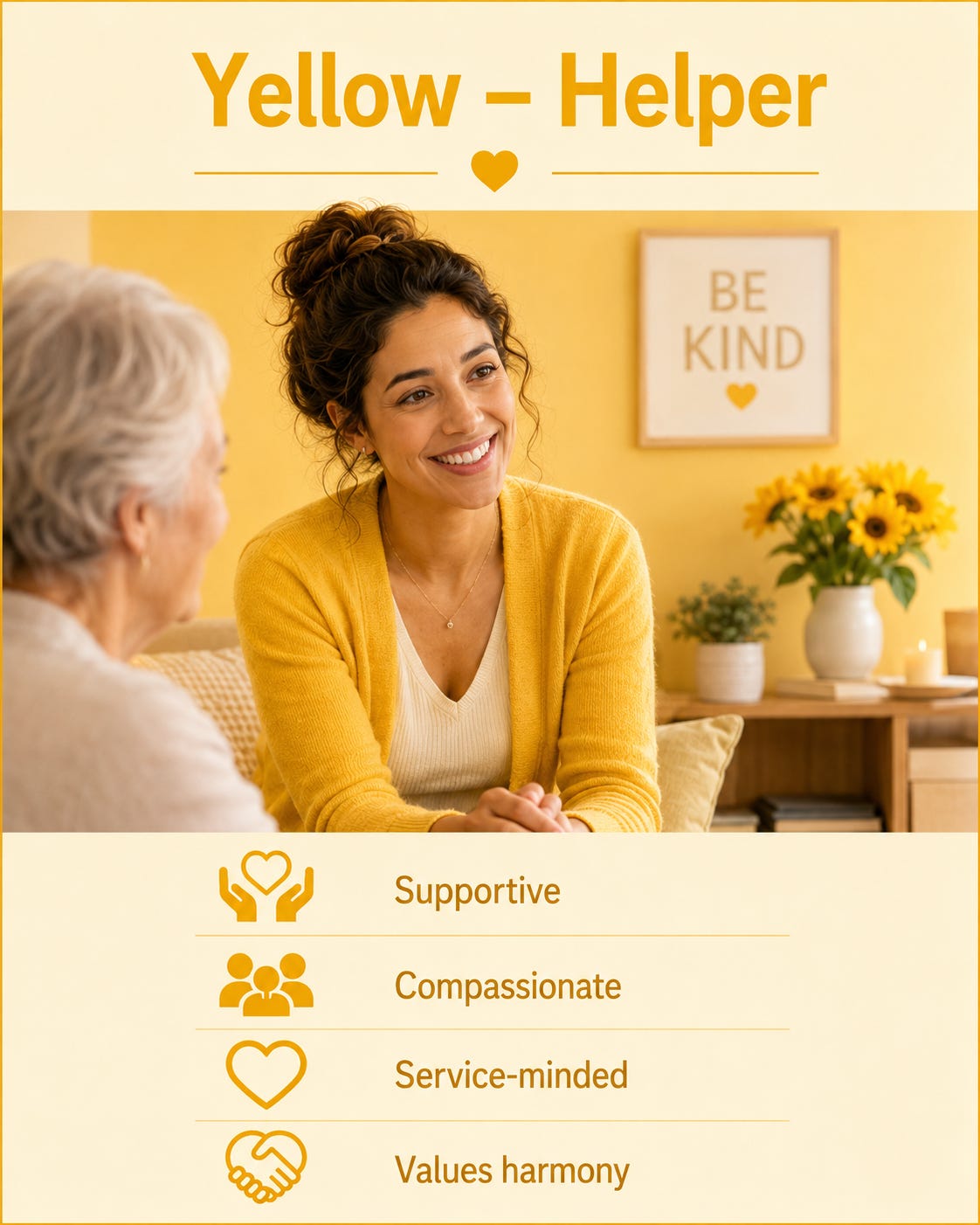
Yellows are relationship-driven, caring, loyal, and motivated by service. They are the helpers, encouragers, peacemakers, and people who naturally notice when someone needs support.
They may be drawn to community, service, encouragement, and a sense of belonging. They want to know: “Will this help people? Will I feel supported? Is this aligned with my values?”
Think of characters like Samwise Gamgee from The Lord of the Rings, Baymax from Big Hero 6, Winnie the Pooh, Big Bird from Sesame Street, or Ned Flanders from The Simpsons. They may be very different characters, but they share warmth, loyalty, and a desire to do good.
A potential pitfall for yellow personalities is that others may see them as indecisive or overly accommodating. But often, they don’t want to force their opinions on others or create unnecessary conflict.
To communicate with a yellow, emphasize people, service, support, and connection.
Blue (the fun one) 🥳

Blues are enthusiastic, social, spontaneous, and energized by excitement. They love adventure, stories, laughter, movement, and trying new things.
They are often the ones who bring energy into a room. They may be the first to say yes to an escape room, a road trip, a party, or any idea that sounds fun enough to figure out the details later.
They want to know: “Is this fun? Who else is doing it? Will this add energy or excitement to my life?”
Think of characters like Genie from Aladdin, Donkey from Shrek, Dory from Finding Nemo, Bugs Bunny, Olaf from Frozen, or Homer Simpson. They may not always be practical, but they are rarely boring.
A potential pitfall for blue personalities is that they can get excited quickly and distracted just as quickly. Details, structure, and follow-through may not be their favorite part of the process.
To communicate with a blue, use stories, enthusiasm, social connection, and energy.
Red (the driver) 🎯
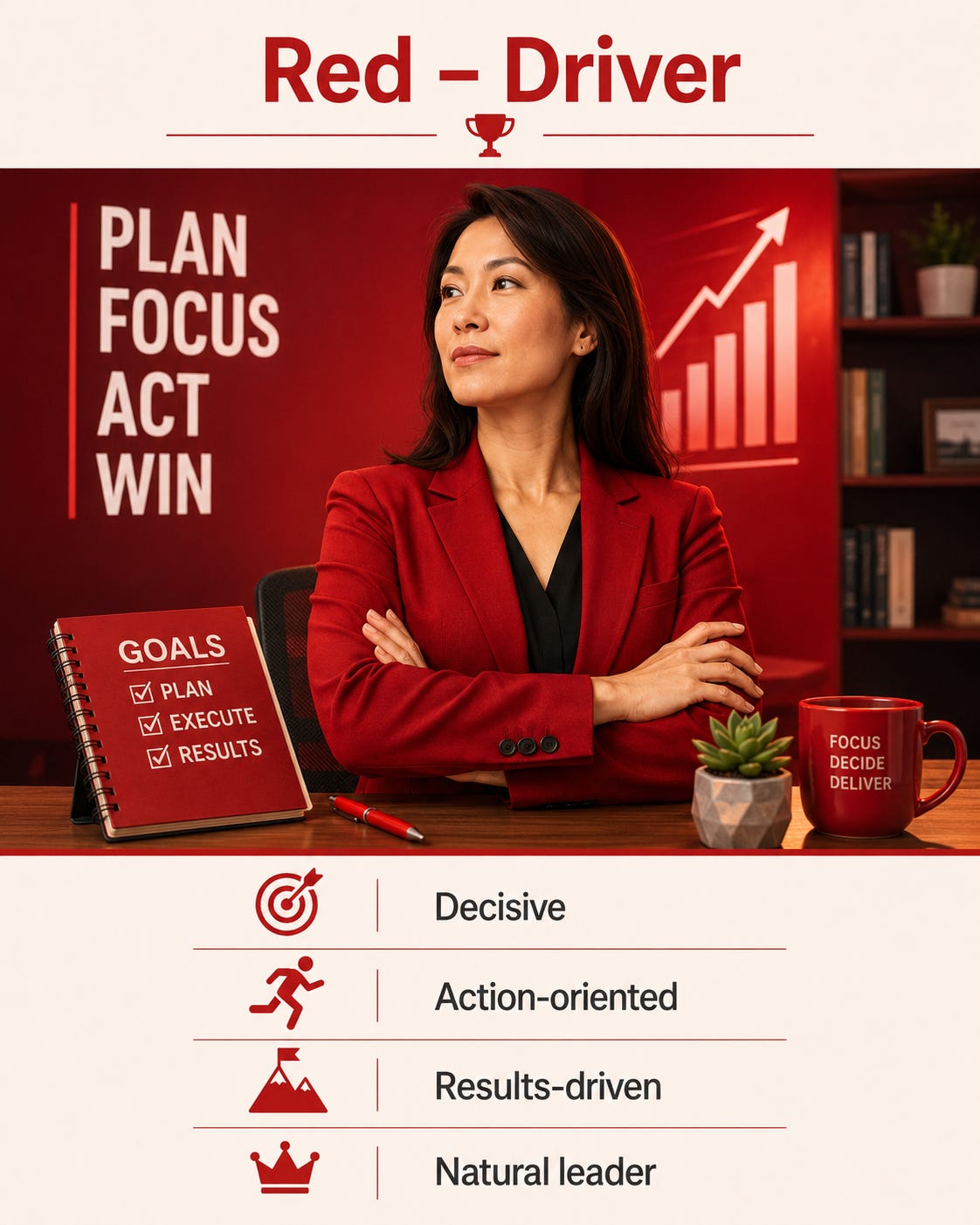
Reds are ambitious, decisive, competitive, and action-oriented. They like momentum and results. They like knowing who is leading, what the goal is, and how to win.
They want to be in charge or at least know that someone competent is in charge. Reds are often direct, confident, and bottom-line focused.
They want to know: “Does this work? What are the results? What’s the fastest path? What’s the next step?”
Think of characters like Tony Stark from Iron Man, Harvey Specter from Suits, Miranda Priestly from The Devil Wears Prada, or Mr. Burns from The Simpsons. Some are heroic, some are intimidating, and some are a little much, but they all carry strong red energy.
A potential pitfall for red personalities is that they can come across as blunt, impatient, or overly focused on winning. Their drive can be inspiring, but it can also steamroll people if they are not paying attention.
To communicate with a red, be direct, show outcomes, and give clear next steps.
Green (the analyst) 🧩

Greens are thoughtful, cautious, research-oriented, and detail-driven. They appreciate data, documentation, logic, and time to think. They don’t want hype. They want proof.
They want to know: “How does this work? Where is the evidence? What are the risks? What details am I missing?”
Think of characters like Spock from Star Trek, Hermione Granger from Harry Potter, Velma from Scooby-Doo, Lisa Simpson, Sheldon Cooper from The Big Bang Theory, or Dilbert. These are the thinkers, researchers, problem-solvers, and question-askers.
A potential pitfall for green personalities is analysis paralysis. They may gather more information than they need before taking action. They may also be more comfortable with books, data, systems, and technology than with emotional conversations.
To communicate with a green, provide facts, details, documentation, and time to evaluate.
Don’t Put People in Boxes
Of course, people are more complex than four colors.
This isn’t about labeling people or reducing them to a personality type. It’s simply a shortcut for noticing what matters to someone in a conversation.
Some people lead with connection.
Some lead with excitement.
Some lead with results.
Some lead with proof.
And most of us are a blend.
The goal isn’t to manipulate anyone. The goal is to listen better.
The best communicators are not always the smoothest talkers. They are often the best listeners. They notice what matters to the person in front of them, and they adjust, not to be fake, but to connect.
When people feel understood, they become much more open to understanding you.

The Daily Habit is where I share my habits related to the fundamentals: sleep, diet, physical activity, mindfulness, and stress management.
Today, in one conversation, pay attention to what the other person seems to value most.
Are they asking about people and relationships?
They may be Yellow.
Are they responding to fun, energy, and excitement?
That may be Blue.
Are they focused on results and next steps?
That may be Red.
Are they asking for facts, details, and proof?
That may be Green.
The habit is simple: before you respond, pause and ask, “What matters most to this person right now?”
That one question can change the whole conversation.
Be Wellthy Club Member exclusives for this newsletter:
Audio commentary
Free online assessment to determine your personality type
Quick-reference guide to the four color personality types
A book recommendation for additional insights
👉 Join the Be Wellthy Club ($7/month or $70/year) for full access to 300+ past issues in the archive, bonus content, exclusive audio, a private podcast RSS feed, and a private Facebook group.
